
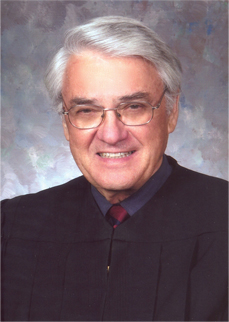
By David Coale of Lynn Tillotson
(Oct. 30) – Patrick E. Higginbotham was born in 1938 in rural Alabama. His father was a dairy farmer who struggled to make ends meet. As a kid, young Pat sold collard greens from the back of the truck to earn extra cash.
When he was 12, the town built a tennis court, which captured Higginbotham’s attention. He traded his hunting knife for a tennis racket and moved into the YMCA when he was 14 to focus on playing tennis. He was good, earning a scholarship at the University of Alabama from its athletic director, legendary football coach Paul “Bear” Bryant.
“Pat grew up poor and knows what it means to have a tough upbringing,” says long-time friend Jim Coleman, a partner at Carrington, Coleman, Sloman & Blumenthal in Dallas. “That experience is part of his character and made him the man and father and judge he is today.”
Higginbotham finished college and law school in just five years. At age 22, he joined the U.S. Air Force JAG Corps, where he tried his first case – a criminal theft matter.
Following the military, he moved to Dallas to join the city’s oldest law firm at the time – Coke & Coke, where he specialized in antitrust litigation.
“I marveled that people would pay me to have so much fun,” Higginbotham says. “The practice of law was a lot different back then. We didn’t keep timesheets until 1966 because no one ever thought about billing by the hour. A partner leaving his or her law firm for another law firm over money was simply unheard of.”

In 1975, President Ford nominated Higginbotham to the U.S. District Court in Dallas, making him the youngest federal judge in the country at the time. He joined the Fifth Circuit in the first wave of Reagan appointees in 1982 and from that position has had enormous influence on that Court, the profession, and those he mentors and teaches.
Higginbotham has authored hundreds of opinions that now shaped fundamental aspects of American law.
In the area of securities law, his LTV opinion from the 1970s essentially wrote the law of “fraud on the market.” Nearly 40 years later, his BP opinion from this year refines and distills today’s major causation theories.
Other landmark opinions address the application of the Voting Rights Act to judicial elections, the continuing and important role of the substantive due process clause in modern economic regulation, and the role of race in admissions at the University of Texas.
Higginbotham has served the bar in roles as diverse as chairman of the Center for American and International Law, which is a globally-respected provider of continuing legal education; chairman of the Advisory Committee on Civil Rules by appointment of Chief Justice William Rehnquist; and chairman of the American Inns of Court Foundation.
His former clerks include the presidents of Princeton University and Unisys Corporation, as well as professors at many major law schools and partners at leading firms. He has taught dozens of law school courses and has been a major voice in the academic and professional literature on the phenomenon of the “vanishing jury trial” in civil cases.
When he speaks in public, Higginbotham displays a sparkling combination of intellect and trial experience, capable of moving instantly from a difficult constitutional issue to a funny story about his youth or a memorable case. His distinctive writing style, instantly recognizable to experienced attorneys in federal practice, blends clever word choice and sentence structure to create succinct, powerful summaries of his legal analysis.
Fifth Circuit Chief Judge Carl Stewart, in an interview, said that’s because there is no judge who is more influential on the appeals court than Higginbotham.
“He has so much experience in so many different subject matters that there’s hardly a case that ever comes before us that he’s not already faced,” Stewart says. “He brings so much perspective and he’s a scholarly student of the law. He knows it like the back of his own hand.”
Now in his late 70s, Judge Higginbotham continues to handle a full caseload. His sprawling intellectual and personal legacy touches virtually every area of law handled by the federal courts. One of the most respected federal judges in the nation, he is truly a lion of the Texas Bar.
David Coale is a partner at Lynn Tillotson in Dallas where he specializes in appellate law. He clerked for Judge Higginbotham.