
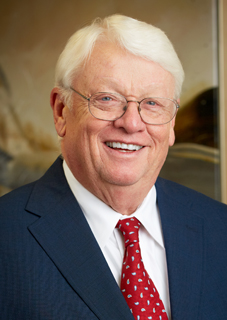
By Mark Curriden
In 1998, Korean conglomerate Hyundai Electronics hired Longview lawyer T. John Ward, a three-decade-long veteran trial lawyer, to defend it against allegations of patent infringement brought by Texas Instruments.
A partner at Brown McCarroll & Oaks Hartline, Ward specialized in products liability law and malpractice litigation. Intellectual property law was as foreign to him as Israeli family law. Yet, he suddenly found himself entrenched in a patent lawsuit in which tens-of-millions of dollars were at stake.
“I’ll be honest with you, I had no idea what a Markman hearing was,” Ward says.
Hyundai lost the case when a jury awarded TI $25 million, but the complex intellectual property litigation left Ward scratching his head about mountains of paperwork, the dreadfully slow pace getting cases to trial and the constant delays.
Eighteen years later, there is no lawyer in the United States more associated with patent litigation than Ward. With apologies to Ben Franklin, no other individual in American history has had a bigger impact on the enforcement of patents.
President Bill Clinton nominated Ward to a judicial opening on the U.S. District Court in the Eastern District of Texas in 1999. From the bench in Marshall, Ward rewrote the rules and procedures lawyers and parties must follow in patent disputes – from the required documentation when a lawsuit is filed, to limiting the discovery process and pushing cases to trial more quickly.
“The Founding Fathers may have created the intellectual property clause in the U.S. Constitution, but T. John Ward made the process for enforcing patents real for individuals and businesses,” says Judge Patrick Higginbotham of the U.S. Court of Appeals for the Fifth Circuit.
“He may be the most prominent figure in the development of patent law,” Judge Higginbotham says. “Oh, and by the way, he’s a damn good trial lawyer, too.”
The American Inns of Court in 2006 named its East Texas chapter the Honorable T. John Ward American Inn of Court. In 2009, the American Board of Trial Advocates named Ward its Trial Judge of the Year.
Ward retired as a federal judge in 2011 and returned to practice law with his son at the firm Ward, Smith & Hill in Longview. He was part of the legal team that won a $175 million jury verdict in a False Claims Act case in 2014, which is one of the largest judgments in East Texas history.
“I have loved every minute of being a lawyer,” Ward says. “Lawyers have the ability to do so much good in our communities. I fear that the practice of law has become too much business and less and less a profession. Part of the reason is that there is so much money involved today.”
Born in Bonham, Texas during World War II, Ward received a bachelor’s degree in chemistry from Texas Tech University in 1964 and a law degree from Baylor University in 1967.
Ward’s first case came on his first day practicing law as a prosecutor in January 1968.
“I showed up for my first day at 8:30 a.m. and was still trying to learn my way around when a secretary walked up to me a few minutes after 9 a.m. and handed me a file,” he says. “The executive director of the YMCA in Lubbock was charged with making alcohol available to minors. She told me that I needed to get to court right away or the justice of the peace was going to dismiss the case. I met my witnesses for the first time a few minutes later.”
Clifford Brown, Lubbock’s best-known criminal defense lawyer, defended the accused.
Ward says Brown’s cross-examination of the state’s witnesses taught him that he had a lot to learn about being a trial lawyer.
“I was proud that the jury took four hours before finding the defendant ‘not guilty,’ ” he says.
“You remember the cases you lose because you feel you are letting down your clients,” Ward says. “I never forgot getting my butt kicked in court, especially when it was against a great lawyer, such as Scotty Baldwin.”
But Ward’s passion was civil litigation, so he joined a law firm that would come to be known as Sharp, Ward, Price & Searcy. He did mostly plaintiff’s work, representing individuals who claimed they had been injured in various products liability, malpractice, fraud or negligence cases.
One of the biggest cases of his career came in 1983, when Ward represented a woman who was seriously injured and whose husband was killed when they were skiing near the Millwood Dam in Arkansas. Cathy Butler slipped and fell into the water. Her husband jumped into the water to help her.
Because the U.S. Corp of Engineers was discharging water at a higher than normal rate, the strong current was overwhelming. The husband died and Butler sustained serious injuries.
A trial judge awarded Butler $1 million for the wrongful death of her husband, but then ruled that the Flood Control Act of 1928 provided the government and its employees sovereign immunity.
Ward appealed to the Supreme Court of the United States, which agreed to hear the case. Ward argued the case on April 21, 1986. He lost the case six to three, but his argument clearly touched Justice John Paul Stevens, who authored an impassioned dissent that was joined by Justices Thurgood Marshall and Sandra Day O’Connor.
“It would be regrettable but obligatory for this Court to construe the immunity provision to bar personal injury claims if such was the intent of Congress,” Justice Stevens wrote. “It defies belief – and ascribes to the Members of Congress a perverse, even barbaric, intent – to think that they spent days debating the measure of extra-constitutional compensation they would provide riparian landowners but intended – without a single word of dissent – to condemn the widows, orphans, and injured victims of negligent operation of flood control projects to an irrational exclusion from the protection of the subsequently enacted Tort Claims Act.”
In later interviews, Justice Stevens identified his dissent in Butler as one of his opinions of which he was proudest. Ward has a personal letter from Justice Stevens about the case hanging in his law firm office.
In 1991, Ward defended a wealthy oil and gas operator accused of civil racketeering charges in Tyler. Plaintiffs sought tens-of-millions of dollars in damages, which the trial judge could treble under federal RICO laws. The trial lasted seven weeks.
“The jury asked to see only one exhibit during their deliberations – the plaintiff’s damage model,” Ward says. “Needless to say, I didn’t get any sleep that night.”
The next day, the jury awarded only $314,000 – an amount that Ward’s client felt was a clear victory.
During his 31 years as a trial lawyer, he tried more than 200 cases to a verdict before a judge or jury.
But there is no dispute that Ward’s biggest successes and influence came during his dozen years as a federal judge in Marshall.
Not long after taking the bench in 1999, Ward decided that most patent cases could be streamlined. He established rules that limited page counts for lawyer motions and briefs. He introduced rigid time limits for hearings. He forced the parties to establish their factual and legal arguments earlier in the case. Lawyers and parties who abused the discovery process were severely punished. The time between a patent infringement lawsuit being filed and the case being set for trial was greatly reduced.
“The goal was to get patent cases to trial within 18 months of being filed,” he says. “I never imagined what the response would be.”
The Eastern District of Texas became known nationally as the “rocket docket.” The impact has been huge.
In 1999, patent holders filed 14 infringement cases in the federal courts in East Texas. By 2006, the number jumped to 234. There were 1,385 patent complaints filed in East Texas during the first six months of 2015, which is more than all the other federal courts in the U.S. combined.
“I’ve always said that it is the law of unintended consequences,” Judge Ward says. “I have tremendous faith in the American jury system. People criticize jury verdicts, but I have found that jurors are hard-working folks who listen closely to the evidence and follow the law.”