
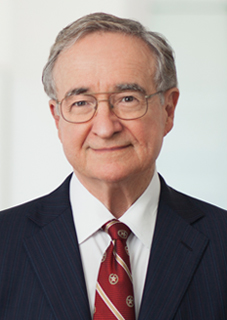
By Janet Elliott
HOUSTON (Oct. 21) – Harry Reasoner’s idea of cutting back at work involves trying one or two major cases a year, handling a number of appeals and leading efforts to help low-income Texans with their civil law needs.
“I regard myself as working half time,” says the 76-year-old Vinson & Elkins stalwart, adding that he could only make such a claim because his wife wasn’t in earshot. “I really enjoy trying cases. There are not many other games I play that well.”
From winning a $1 billion judgment in an antitrust case to heading a 30-year effort to insure prison inmates’ First Amendment rights, Reasoner combines a litigator’s instinct with a strong sense of social justice.
Much of his proudest work – in the prison litigation and defending affirmative action in the Hopwood case involving the University of Texas School of Law – has been done pro bono.
“Figuring out how to educate our minority populations and people who grow up in poor economic circumstances is one of the most important problems our country faces, particularly in a state like Texas,” says Reasoner.
His easygoing, charming demeanor has helped him connect with jurors and disarm news reporters. He is credited with helping defend V&E’s reputation when its high-profile client Enron collapsed in spectacular fashion in 2001. Reasoner reassured clients and calmly endured questions from reporters looking to implicate the firm in the Enron scandal.
One of his favorite clients was “60 Minutes” correspondent Ed Bradley, who was sued for libel in connection with a report about an El Paso colonias developer. When a federal jury cleared Bradley and CBS after a 1997 trial, Bradley asked Reasoner what to say to the press.
“Ed, just tell them that sometimes the truth hurts,” Reasoner advised, and a beaming Bradley did just that.
When antitrust litigation was hot, Reasoner was in trial a lot. A big win came in 1989 when his trial team won a $1 billion jury verdict and judgment against western railroads that had conspired to block a coal slurry pipeline.
He obtained a take-nothing jury verdict for The Dallas Morning News in a $100 million antitrust suit brought by its competitor, the Dallas Times Herald. “It was a dangerous case because the Times Herald was going out of business and the competition by the Morning News had been hard ball,” says Reasoner.
From 1992-2001, Reasoner served as managing partner of the firm. Unwilling to give up his practice, he continued to play a key role in big cases. He won several hundred million dollars for Shell in an eight-month arbitration in Washington D.C. over responsibility for leaking plastic plumbing pipes that had caused problems for homeowners around the country.
Reasoner says the business demands of today’s law firms probably require a full-time managing partner. “It was hard to keep both balls in the air and I probably shouldn’t have tried,” he says.
His modesty downplays significant accomplishments during his tenure running the firm. Longtime colleague and fellow Lion Carol Dinkins lauds Reasoner’s leadership in persuading the management committee in 1997 to extend benefits to same-sex partners of the firm’s employees.
“Harry introduced that matter with such ease and in such a matter-of-fact way,” says Dinkins. “It was not a hard-fought debate. It was not a crisis in discussion. It was very calm, very thoughtful, and it was accomplished, and I think that’s a matter of great pride for Harry and our law firm.”
Reasoner recalls that some firm leaders were concerned about client backlash when V&E became the first Houston firm to recognize the rights of gay lawyers.
“We reached a consensus that we should do the right thing and felt we could deal with any client backlash. If we lost some business for doing the right thing, we were willing to accept that consequence,” says Reasoner. “I did not receive any complaints and we are not aware of any clients we lost because of it.”
In recent years, Reasoner represented the grandchildren of firm founder James Elkins in a dispute with the IRS over the value of their fractional interests in an inherited art collection. In 2014, the U.S. Court of Appeals for the Fifth Circuit ordered a $14.4 million refund in a ruling that affirmed the use of fractional interest discounts to reduce estate taxes on artworks.
Pablo Picasso, Jackson Pollock, Paul Cézanne and Henry Moore were among the artists represented in the collection. “It was fascinating to try because I got to learn about the art,” says Reasoner.
Like many of his contemporaries, Reasoner is concerned about the decline in jury trials and the difficulty that presents for young lawyers needing trial experience. He is critical of Congress for failing to keep federal judicial pay at reasonable levels and to provide adequate resources and technology for the courts.
Social justice remains a focus for Reasoner, who chairs the Texas Access to Justice Commission. He says the dramatic reduction in federal funds for legal services means the commission has to work even harder for state funding and to coordinate self-help efforts for pro se litigants.
“When they need a lawyer we have to turn four of five away because we don’t have the resources.” Reasoner says. “In 67 percent of divorces in Texas, people try to represent themselves.”