[fusion_builder_container hundred_percent=”yes” overflow=”visible”][fusion_builder_row][fusion_builder_column type=”1_4″ last=”no” spacing=”yes” center_content=”no” hide_on_mobile=”no” background_color=”” background_image=”” background_repeat=”no-repeat” background_position=”left top” hover_type=”none” link=”” border_position=”all” border_size=”0px” border_color=”” border_style=”” padding=”” margin_top=”” margin_bottom=”” animation_type=”” animation_direction=”” animation_speed=”0.1″ animation_offset=”” class=”” id=””][fusion_imageframe lightbox=”no” lightbox_image=”” style_type=”none” hover_type=”none” bordercolor=”” bordersize=”0px” borderradius=”0″ stylecolor=”” align=”none” link=”” linktarget=”_self” animation_type=”0″ animation_direction=”down” animation_speed=”0.1″ animation_offset=”” hide_on_mobile=”no” class=”” id=””] 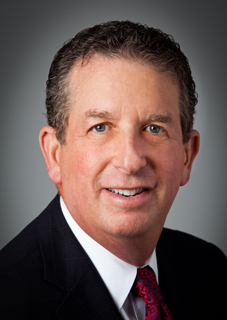 [/fusion_imageframe][/fusion_builder_column][fusion_builder_column type=”3_4″ last=”yes” spacing=”yes” center_content=”no” hide_on_mobile=”no” background_color=”” background_image=”” background_repeat=”no-repeat” background_position=”left top” hover_type=”none” link=”” border_position=”all” border_size=”0px” border_color=”” border_style=”” padding=”” margin_top=”” margin_bottom=”” animation_type=”” animation_direction=”” animation_speed=”0.1″ animation_offset=”” class=”” id=””][fusion_text]By Mark Curriden
(June 14) – In the world of business transactional law, Gil Friedlander has done it all. He’s represented high-profile corporate clients in some of the largest and most complex transactions ever.
He handled the $4.9 billion leveraged buyout of 7-Eleven during a stock market crash and the $1.3 billion sale of Chuck E. Cheese. He negotiated an unprecedented $3.2 billion IT contract with Xerox and led the $500 million acquisition of A.T. Kearney, the world’s fourth largest management consulting firm.
And then there was the mother of all complex corporate transactions – the “split-off” of Plano-based Electronic Data Systems from General Motors in a transaction valued at $25 billion.
As the general counsel of EDS, he also got to fire two of his own CEO bosses – a task that Friedlander says it is not as much fun as it sounds.
“I would love to tell you that I enjoyed every minute of it, but I can honestly say I’ve enjoyed most of it,” he says. “There have been some extraordinary times and successes, but the practice of law naturally brings disappointments and failures and frustrations – and even some scary times.”
Friedlander was born in Hazelton, PA. His father was a traveling salesman of various goods, including shoes and aluminum roofs. While in college at the University of Texas, he thought about becoming a dentist, but concluded that he hated using tools and chose law school instead.
“Law school was eye-opening for me when it came to competition,” he says. “Most importantly, law school taught me critical thinking.”
After getting his law degree from the UT in 1971, Friedlander went to work at Dewey Ballantine, a white-shoe corporate law firm based in New York.
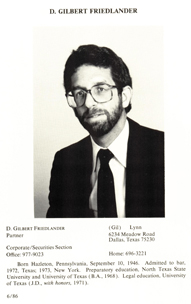 “I think I was only the second southerner to ever work at Dewey,” he says.
In 1974, Friedlander moved to Dallas and joined Hewlett, Johnson & Swanson as the firm’s 18th lawyer. He was assigned to its corporate section, where he was made partner in only five years.
“The firm grew quickly and truly became a transformative model for other corporate law firms in Texas,” he says. “We were the first law firm to approach the law practice as a business.”
The firm represented First National Bank, the Hunt family businesses and SBIC Funds, a financial firm where leveraged buyout businessman Tom Hicks got his start.
Friedlander and his group represented issuers and underwriters in securities offerings.
In 1987, JT Acquisition, a private equity firm owned and operated by Southland Corp. Chairman John Thompson and the Thompson family, hired Friedlander to lead an effort to take Southland private. The Thompson family, through the private equity firm, possessed the controlling interest in Southland, which included 7-Eleven Stores as a subsidiary.
“It was a completely leveraged buyout – no real equity involved,” he says. “The family believed there would be more longer-term growth opportunities if the company was private.”
In July 1987, the parties reached a deal. JT Acquisition proposed to pay $77 a share for Southland for a total of $4.2 billion. The Thompson family planned to finance the transaction with a $2.73 billion bank loan, the proposed sale of $1.5 billion in junk bonds and a $600 million bridge loan from Goldman Sachs and Salomon Brothers.
Many Wall Street analysts viewed the proposed transaction as high-risk and over-leveraged – and that was before Oct. 19 occurred.
Black Monday.
The stock market crashed. The Dow Jones lost nearly 23 percent of its value in a matter of hours. Southland’s stock price and value plunged with it.
“It was a very scary time for everyone, including the banks and investment banks involved in this deal,” Friedlander admits.
The market crash added severe pressure on the transaction. JT was unable to raise the $1.5 billion through the sale of junk bonds because they could find no buyers even with an 18 percent coupon.
The deal team, however, developed a variety of financing features and asset sales that allowed the transaction to close in mid-December, although the price tag increased to $4.9 billion due to the expensive nature of the financing.
“The more complex the transaction, the more fun it is,” Friedlander says.
The Southland deal, according to Friedlander, “was the beginning of the end for investment banks to issue ‘highly confident letters’ to companies” – letters that give assurance to a corporate board of the ability to finance a transaction.
About 18 months later, Friedlander was part of the Johnson & Swanson team that represented the Thompson family when JT Acquisitions filed for protection under Chapter 11 of the U.S. Bankruptcy Code.
In 1991, Friedlander met with EDS officials at the Crescent Club, where he was offered the job of general counsel – a position he could not refuse.
“EDS was growing and it was a great opportunity to jump in-house,” he says.
Friedlander’s first five years on the job at EDS were crazy busy. He negotiated an unprecedented $3.2 billion IT contract with Xerox, purchased New Zealand’s Databank Systems for $100 million and guided the $500 million acquisition of A.T. Kearney, the world’s fourth largest management consulting firm.
“Being the GC of a large corporation is a 24-hour-a-day, seven-day-a-week job,” he says. “There were always huge legal and business decisions that needed to be made.”
General Motors bought Ross Perot’s EDS in 1984 for $2.5 billion. As a subsidiary of GM, EDS revenues exploded over the next 10 years. The company’s value skyrocketed to $21 billion by 1994.
“The management and cultural styles at EDS, an IT services company, and GM, a Rustbelt manufacturer, often clashed,” Friedlander says. “The two companies had different growth trajectories and different compensation systems. Executives at EDS wanted to separate or exit from GM to accelerate its growth and GM executives were unhappy with EDS’ leadership.”
Friedlander says bad feelings lingered after the clashes between GM CEO Roger Smith and Perot, who served on GM’s board.
A perfect example, according to Friedlander, was EDS’ efforts in 1994 to negotiate multibillion-dollar mergers with Sprint Corporation and British Telecomm, which did not get finalized in significant part due to GM.
While EDS was a fully owned subsidiary of GM, auto manufacturer issued a public “tracking stock” known as GME when it acquired EDS. The use of GME stock, the value of which rose and fell on the results of EDS’ performance and not that of GM, created tension for GM’s board’s in fulfilling its fiduciary duties to its own stockholders and those who owned GME.
In addition, EDS had its own board of directors.
There were also other complications, including the fact that GM accounted for nearly one-third of EDS’ business. This relationship prevented EDS from seeking business contracts with GM’s competitors.
In the summer of 1995, the GM board officially gave its approval for representatives of the two companies to begin negotiations to severe ties with EDS. Meanwhile, the world’s largest automaker faced its own emerging issue – a huge unfunded pension liability for its union workers.
Friedlander turned to Baker Botts to advise on the transaction. The deal team worked nearly non-stop for six months to develop the terms. ERISA lawyers at Baker Botts came up with a proposal that gave about 40 percent of the new shares of EDS stock to the GM pension fund. EDS also agreed to make a one-time $500 million “dividend” payment to GM.
The deal hinged on obtaining an IRS ruling about whether these kind of “split-offs” – not to be confused with a “spin-off,” which is what happens when companies distribute shares to stockholders instead of exchanging them for new shares in the company – was tax-free for GM.
In early 1996, the IRS gave the thumbs up and the transaction closed in April of that year. The GM board, in conjunction with the “split-off,” also awarded EDS a 10-year, multibillion-dollar information technology services contract.
“It was a pretty extraordinary transaction that unlocked a lot of value for EDS,” Friedlander says.
The lawyers involved in the deal are amazed to this day that Friedlander was able to make it work.
“The EDS-GM deal was clearly one of the most difficult and most complex deals I have ever been involved in,” says Andy Baker, who is now managing partner at Baker Botts. “Gil faced a hire-wire act. He had to take into account the interests of many different stakeholders. He demonstrated extraordinary emotional intelligence. He understood what people needed and he maintained credibility with all of them.”
In the months that followed, Friedlander oversaw numerous billion-dollar contract agreements, including one with the U.S. Navy, which wanted EDS to revamp its entire IT system.
There were some not-so-pleasant times at EDS, too.
In August 1998, EDS Board Chairman James Baker, now a lawyer at Baker Botts, approached Friedlander with news that they were about to fire CEO Les Aberthal, who had nearly quadrupled revenues at EDS during his 12-year tenure. Aberthal was well-liked, but EDS stock had underperformed.
“The general counsel reports to the CEO and to the board and GCs have to know how to balance those duties,” Friedlander says. “It was tricky waters. My job was to negotiate their exit packages.”
Five years later, in 2003, EDS pushed out its second CEO, Dick Brown, and the company’s board again turned to Friedlander to handle the details.
“Helping get rid of your boss is not nearly as enjoyable as most people might think,” he says.
Friedlander retired from EDS in 2004 and joined Weil, Gotshal & Manges as a partner, where he was involved in several major mergers, including representing Chuck E. Cheese in its $1.3 billion sale to Apollo Management in January 2014.
In Oct. 2014, Friedlander joined Sidley Austin’s office in Dallas. His practice focuses primarily on internal investigations regarding corporate governance matters.
“The practice of law has changed greatly,” he says. “The billable hour provides perverse incentives for lawyers. The practice of law is depersonalized. It’s horrible for clients. The relationship between clients and lawyers is suffering. Many times, you never meet opposing counsel and sometimes you don’t even meet your own client.
“The law as a profession is not dead yet, but it is in critical condition,” Friedlander concludes.[/fusion_text][/fusion_builder_column][/fusion_builder_row][/fusion_builder_container]