[fusion_builder_container hundred_percent=”yes” overflow=”visible”][fusion_builder_row][fusion_builder_column type=”1_4″ last=”no” spacing=”yes” center_content=”no” hide_on_mobile=”no” background_color=”” background_image=”” background_repeat=”no-repeat” background_position=”left top” hover_type=”none” link=”” border_position=”all” border_size=”0px” border_color=”” border_style=”” padding=”” margin_top=”” margin_bottom=”” animation_type=”” animation_direction=”” animation_speed=”0.1″ animation_offset=”” class=”” id=””][fusion_imageframe lightbox=”no” lightbox_image=”” style_type=”none” hover_type=”none” bordercolor=”” bordersize=”0px” borderradius=”0″ stylecolor=”” align=”none” link=”” linktarget=”_self” animation_type=”0″ animation_direction=”down” animation_speed=”0.1″ animation_offset=”” hide_on_mobile=”no” class=”” id=””] 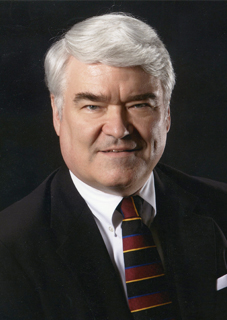 [/fusion_imageframe][/fusion_builder_column][fusion_builder_column type=”3_4″ last=”yes” spacing=”yes” center_content=”no” hide_on_mobile=”no” background_color=”” background_image=”” background_repeat=”no-repeat” background_position=”left top” hover_type=”none” link=”” border_position=”all” border_size=”0px” border_color=”” border_style=”” padding=”” margin_top=”” margin_bottom=”” animation_type=”” animation_direction=”” animation_speed=”0.1″ animation_offset=”” class=”” id=””][fusion_text]By Mark Curriden
(Jan. 23) – Nathan Hecht has been on the Supreme Court of Texas for more than 10,000 days over the past 29 years – longer than any other justice in state history.
And he’s promising he will not put down the gavel for at least eight more years.
Now chief justice, Hecht has been elected to the state’s highest court a record six times and another three times to lower courts. He has authored nearly 400 opinions.
Legal experts say Hecht’s biography of achievements is impressive. He played a crucial role raising juror pay from $6 to $40 a day. He pushed the state legislature to significantly increase funds for legal aid for the poor. He led the way in establishing a statewide electronic court filing system, and he helped create legal assistance programs for veterans.
Most importantly, appellate court analysts say Hecht engineered a dramatic and historic shift at the Supreme Court, making it more conservative, more pro-business and much more skeptical of large damage verdicts issued by Texas judges and juries.
At the same time, he has on his agenda efforts to make legal services more accessible to the middle class and small businesses. And he is working closely with leaders at the new University of North Texas School of Law to ensure the institution is successful in its mission of producing young lawyers with considerably less debt.
No single lawyer has made a bigger impact on the legal system in Texas than Nathan Lincoln Hecht, according to legal historians.
“Being on the Texas Supreme Court is the greatest honor of my life,” Hecht says. “I have enjoyed every minute of being a lawyer and being a judge. It is a position that comes with tremendous responsibilities and challenges.”
Now at age 67, Hecht says he has no plans to retire when his current term ends in 2020. Instead, he plans to stay on the bench until he turns 75, which will be 2024.
“I can’t imagine not practicing law,” he says. “If I had the talent, I’d be a pianist. And if I had the patience, a minister or teacher.”
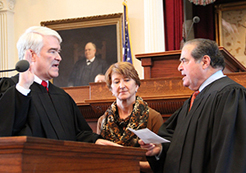 Hecht’s fellow justices recognize the importance of his tenure on the court, as well as his leadership role in reshaping Texas courts to be more conservative in addressing civil litigation but more progressive in their approach to social justice needs.
“He’s the psuche of the Supreme Court – unrivaled intellect, cracker-jack writing, mastery of all things rule and administration-related and a steadfast commitment to ensuring court access for low-income Texans,” Justice Don Willet said in a previous interview with The Texas Lawbook.
Hecht studied philosophy at Yale University, where he graduated with honors. He then earned a doctor of jurisprudence from SMU Dedman School of Law in 1974.
“I thought I was good in math and I went to college to be an engineer,” Hecht says. “But I quickly learned that I wasn’t as good in math as I thought, and I switched my major.”
After a one-year clerkship with Judge Roger Robb of the U.S. Court of Appeals for the DC Circuit, Hecht served as a lieutenant in the U.S. Naval Reserve Judge Advocate General Corps at the Corpus Christi Naval Base, where he tried his first cases as a lawyer.
Life as a Lawyer
Hecht represented a Seaman First Class who was charged with failure to go to his duty station, failure to obey the commanding officer and numerous other counts.
“My client was asleep in his bunk when a second seaman urinated on him,” Hecht says. “The next day, someone whacked the second seaman with a broom handle, though no one would admit to seeing it.
“The commander was tired of disciplinary issues and threw the book at my client,” he says. “My client faced being dishonorably discharged, loss of pay and about 20 years in the brig.”
The military court consisted of six officers and six enlisted men. Hecht argued that the charges and sentence were unfair, that there were no witnesses to prove the prosecution’s case and that the captain who brought the charges had barely met with the seaman.
“The charges were trumped up,” he says. “The court was out only 30 minutes before rejecting nearly all the charges and simply gave him a dishonorable discharge, but allowed him to keep his pay.”
 In 1975, he joined the litigation practice of Dallas-based Locke Purnell Boren Laney & Neely, which is now known as Locke Lord.
The law firm threw Hecht into the fire during his first year as an associate by making him second chair in a multimillion-dollar antitrust trial.
Hecht and the Locke Purnell team represented Pat Zachry and his huge construction company in a lawsuit brought by a small concrete business.
“The plaintiff claimed that our client and other concrete providers conspired to put him out of business,” he says. “I was responsible for witness preparation and preparing the charge to the jury.”
A handful of defendants settled their cases before trial, but the Locke Purnell team was confident in its argument. The two-week trial ended with the jury giving Hecht and the defense a complete victory.
‘Always Wanted to be a Judge’
Locke Purnell made Hecht a shareholder in 1980, but he wasn’t there long. In 1981, Texas Gov. Bill Clements appointed Hecht to the state district court in Dallas.
“I always wanted to be a judge, but the offer was still a surprise when it came,” he says.
A year later, Dallas County residents voted to keep Hecht on the bench. In 1986, he ran for and won a seat on the Texas Court of Appeals for the Fifth District in Dallas.
In 1988, three justices on the Supreme Court of Texas retired. No registered Republican had been elected to the state’s highest court since Reconstruction.
At age 39, Hecht threw his hat into the ring. His timing was perfect. Three Republicans – Hecht, Tom Phillips and Eugene Cook – were elected, marking the start of a huge shift at the state’s highest court.
Asked to identify what he believes to be the most important opinion he’s authored during his 28 years on the Texas Supreme Court, Hecht points to a 1991 decision in which he set new rules for when Texas judges can issue sanctions against parties in a litigation and how severe those sanctions can be.
The case pitted Houston-based TransAmerican National Gas Corp. against Toma Steel Supply. TransAmerican sued Toma, claiming pipes it purchased from the Colorado business were defective. Toma counter-sued when TransAmerican refused to pay for the pipes.
The litigation, then, took a weird turn when TransAmerican and its outside counsel repeatedly cancelled the deposition of the company’s president and then declined to make the executive available to Toma’s lawyers within the discovery deadline set by Harris County District Judge William R. Powell.
At the request of Toma, Judge Powell issued an order imposing severe sanctions for discovery abuses against TransAmerican, including striking all of TransAmerican’s pleadings and issuing default judgment in favor of Toma.
TransAmerican filed a mandamus petition, asking the Texas Supreme Court for relief.
Writing for the court, Hecht held that that “a direct relationship must exist between the offensive conduct and the sanction imposed” when judges issue tough sanctions against parties in a case.
“This means that a just sanction must be directed against the abuse and toward remedying the prejudice caused the innocent party,” he wrote. “The point is, the sanctions the trial court imposes must relate directly to the abuse found.”
Hecht also noted that “sanctions must not be excessive” and “should fit the crime.”
“A sanction imposed for discovery abuse should be no more severe than necessary to satisfy its legitimate purposes,” he wrote. “It follows that courts must consider the availability of less stringent sanctions and whether such lesser sanctions would fully promote compliance.”
In reversing Judge Powell’s ruling, Hecht stated, “Sanctions which are so severe as to preclude presentation of the merits of the case should not be assessed absent a party’s flagrant bad faith or counsel’s callous disregard for the responsibilities of discovery under the rules.”
Hecht’s landmark opinion in TransAmerican has been cited thousands of times by judges in Texas and across the U.S. as a landmark decision.
Similarly, Hecht’s opinion in Gammill v. Jack Williams Chevrolet has been cited by courts more than 3,000 times. The justice wrote that the opinions of experts should be treated the same as other testimony based on specialized or technical knowledge.
“The trial court is not to determine whether an expert’s conclusions are correct, but only whether the analysis used to reach them is reliable,” Hecht wrote in 1998.
‘Becoming Chief Justice’
In 2014, Texas Gov. Rick Perry appointed Hecht to the position of chief justice, replacing Wallace Jefferson, who stepped down to return to the practice of law.
Legal experts say Hecht’s impact on the state’s courts and civil litigation has been enormous – and very pro-business. They say he has pushed the Supreme Court to aggressively enforce tort reform laws that limit people’s rights to win large damage awards against corporations and insurance companies.
 Hecht’s opinions also come at a time when the Texas Legislature has been codifying civil rules and procedures, a task previously handled by judges in the state.
“Fewer cases involve the common law — judge-made law, like negligence and other torts, property rights, and contracts,” Hecht told the Texas Legislature in 2015. “More involve statutory interpretation. In these cases, courts do not decide for themselves what the law should be; rather, their responsibility is to give effect to the intent of the legislative body as expressed in the statutory text.”
But Hecht also has been an aggressive advocate of funding legal aid for those who cannot afford a lawyer.
“Access to justice and legal aid is not a Republican issue, and it isn’t a Democratic issue,” Hecht says. “It is about ensuring basic fairness and access to everyone.”
Hecht says the state needs to look at further limiting or tailoring discovery in civil disputes, especially in the area of electronic discovery, which is very expensive. He also wants to work with the law schools in Texas to make curricula more practice-focused.
“The civil justice system is just too expensive,” he says. “We have to look at the whole structure of the justice delivery system in our state. Most people simply cannot afford to access our justice system.”
Hecht says his 28 years as a Texas Supreme Court justice have been amazing.
“I got to meet Queen Elizabeth in May 1991 when she visited the Governor’s Mansion,” he says. “We were told to not engage in conversation or to make any sudden moves toward her and to simply take her hand and say ‘Your Majesty’ if she offered it.
“But Justice Raul Gonzalez couldn’t contain himself and wanted to give her a hug, but the protocol folks jumped in to stop it,” Hecht says.
The chief justice also remembers a handful of strange moments at the court. One lawyer, who had been up all night preparing for oral argument, passed out as she stepped to the lectern. Justice Hecht doesn’t remember whether she won or lost the case.
And then there’s the issue of cell phones, which are supposed to be turned off in the courtroom.
“Right in the middle of oral argument, a cell phone starts ringing and just kept ringing,” Hecht said. “We all looked around the courtroom to see whose phone it was.
“It was the chief justice’s,” he said with a laugh.
Photos courtesy State Bar of Texas
[/fusion_text][/fusion_builder_column][/fusion_builder_row][/fusion_builder_container]