
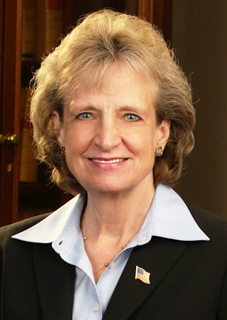
By Mark Curriden
(Dec. 6) – Harriet Miers is the epitome of what it means to be a lawyer. She zealously advocates for her clients. She cherishes the rule of law.
She fought to preserve the sacrosanct relationship between lawyers and their clients. She championed the need for improved legal services for the poor. She shattered numerous glass ceilings for women lawyers in Texas, including becoming the first women to lead a large, full service law firm.
Then, there were those years not long ago when Miers stepped away from a lucrative partnership at a large law firm to take a position in the federal government – policy adviser and later chief legal counsel to the President of the United States.
For Miers, law is not simply a business – it is a noble profession.
“Lawyers especially have an obligation to give back to society, to defend the rule of law, to work to improve our legal system, and to take steps to ensure that all of our citizens, including the most vulnerable among us, have access to the justice system,” she said.
Born and raised in Dallas, Miers attended public schools. She studied math in college and planned to be a teacher. When her father suffered a stroke, the family faced serious legal issues.
“A lawyer stepped forward to help us get through the tough times,” she said. “I admired him greatly and decided then that I really wanted to be a lawyer.”
During her second year at the SMU Dedman School of Law, Miers worked as a summer associate in the law offices of legendary plaintiff’s lawyers Melvin Belli and Robert Leif.
“It was an amazing experience,” she said. “Belli asked me to help write an article on a no-fault divorce law that had just passed in California. It was a lot of fun.”
After graduating from SMU Dedman in 1970, Miers clerked for two years for Chief Judge Joe Estes of the U.S. District Court in Northern District of Texas.
“There were very few women in law school and very few law firms offering lawyer jobs to women,” she said. “Judge Estes was like a second father to me. He called law firms recommending me for a position. He was surprised at the hesitancy of firms to hire a woman.”
Locke Purnell said “yes,” but hired Miers as a lawyer in its corporate M&A section, not litigation where she wanted to be. Fortunately, her big break came quickly.
Six months after being hired, a Locke Purnell trial lawyer who practiced in Texas state courts was facing a trial in federal court.
“He came to my office and said he knew that I knew federal procedure and rules from clerking with Judge Estes and that I knew how things worked around the federal court,” she said. “He asked if I would help him with the litigation. I jumped at the opportunity.”
Miers’ career skyrocketed. Locke Purnell voted her into the partnership in 1978, making her the first woman to be a partner at a major Dallas law firm. In 1986, the Dallas Bar Association voted Miers its first woman president. Six years later, she became the first woman to be president of the State Bar of Texas. And she served two years on the Dallas City Council.
In 1996, Locke Purnell made Miers the first woman to lead a major Texas law firm. As the firm’s president, she engineered its merger with Houston-based Liddell Sapp.
During her 45-year career, Miers successfully represented scores of businesses, including Microsoft and Disney, in huge business disputes in which tens or even hundreds of millions of dollars were at stake.
Miers, who is 71, has demonstrated her commitment to pro bono throughout her career by tackling various projects and cases. In the late 1990s, she represented an African woman and her child in an asylum petition.
The woman’s husband, who was a white U.S. citizen, tried to have her and her child deported after the couple divorced. Because the child was bi-racial, the mother knew she would be unwelcomed in her homeland and likely targeted for persecution.
Miers said the facts in the case were heartbreaking, but the case fortunately ended well, as the mother was granted asylum.
Finally, let’s not forget about Miers’ most famous client: President George W. Bush.
Miers first served as general counsel for the transition team when Bush was elected governor of Texas in 1994. In 2000, she represented Bush in a federal lawsuit claiming that Bush and his vice presidential running mate, Dick Cheney, could not run on the same presidential ticket because they were from the same state. The case was dismissed.
In 2001, Miers left the law firm to move to Washington, D.C., to serve as assistant to the president and later as deputy chief of staff for policy.
 President Bush, who once described Miers as a “pit bull in size six shoes,” promoted the Dallas lawyer to White House Counsel in 2005 – a position she held for two years. She was only the second woman in history to serve in the position.
“Working for the United States and the president is a remarkable experience,” she said. “This nation does amazing things around the world to make a difference and I got to see that first hand from the White House.
“It is the pinnacle of anyone’s career to be the legal adviser to the president of the United States,” she said.
In 2005, President Bush nominated Miers to be an associate justice on the Supreme Court.
“In selecting a nominee, I’ve sought to find an American of grace, judgment and unwavering devotion to the Constitution and laws of our country,” President Bush said. “Harriet Miers is just such a person. I’ve known Harriet Miers for more than a decade. I know her heart. I know her character.”
Some political leaders on the far left and the far right criticized Miers’ nomination, pointing out that she had never served as a judge before. But those politicians apparently were ignorant of a few other Supreme Court justices – Chief Justice John Marshall, Justice John Marshall Harlan, Chief Justice Earl Warren and Chief Justice William Rehnquist, to name a few – who had not been trial or appellate court judges.
Sadly, Miers withdrew as a candidate after a month, but she still says it was “an extraordinary experience.”
“Justice Harriet Miers,” former Supreme Court Justice Sandra Day O’Connor told me once in an interview, “she would have added a humbleness and a common sense that is greatly needed on the Court.”
At a CLE program at SMU Dedman School of Law in 2016, Miers said there were three key elements that have changed the practice of law during her career.
“The first is technology,” she said. “We thought we had seen it all when we first saw the fax machine. Now, we talk in terms of search algorithms and electronic discovery.”
Miers said lawyers went from representing clients in Dallas and North Texas to representing them statewide, then across the southwest and nationwide.
“Now, we are all doing international work – or at least wanting to do more international law and wondering why we are not,” she said.
Finally, there is the issue of diversity.
“Used to be, when I walked into a room for a meeting, or a deposition or a court hearing, all the other participants were male,” said Miers, who pointed out that it is much different today with much greater gender and ethnic diversity.
“Now, when I walk into the room and look around, all of the lawyers are young,” she said, causing the room to erupt into laughter.